What Is NIL?
The Simple Guide to Name, Image, and
Likeness in College Sports
A complete timeline of the rules, the revenue, and the difference between NIL and a salary.
Mar 09, 2026
You're a 19-year-old college quarterback. Your jersey sells out in the campus bookstore. Your face is plastered on billboards. A video game company puts your throwing motion into its latest release. Millions tune in on Saturdays to watch you play.
And you? You get… a scholarship and a meal plan.
For decades, that was the deal. Play your heart out. Generate billions for your university. And don't you dare accept a dollar in return because "amateurism."
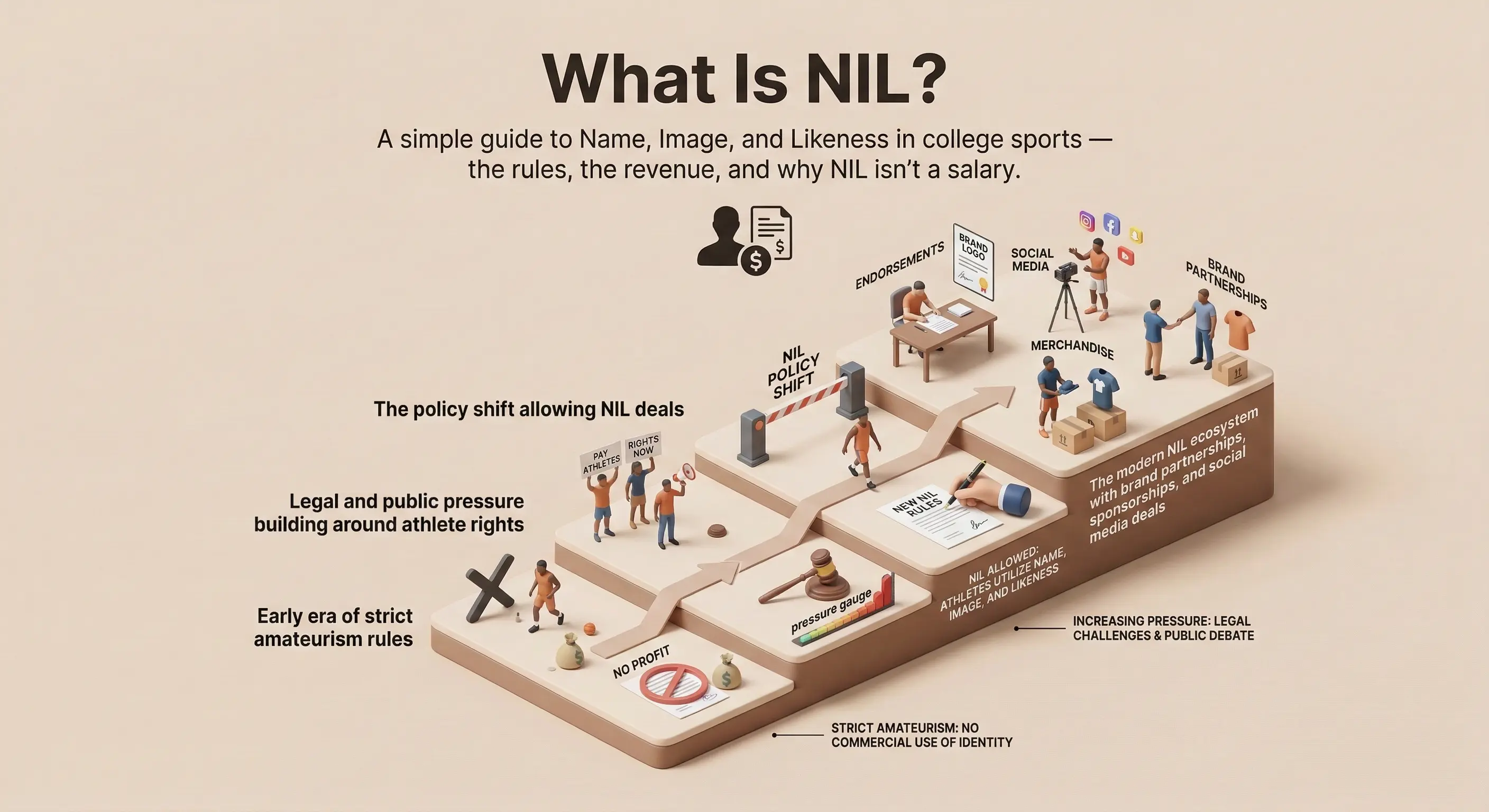
Then, in July 2021, everything changed. College athletes could finally profit from their Name, Image, and Likeness or as the sports world now calls it, NIL.
But how did we get here? What does NIL actually mean? And is this the same as "paying players"?
Let's break it all down. No jargon. Just the story.
🎓 First, What Exactly is NIL?
NIL stands for Name, Image, and Likeness. It's a legal concept that says: you own the commercial rights to your identity your name, your photograph, your persona.
For regular people, this isn't news. If a company wants to slap your face on a billboard, they need your permission (and probably your invoice). But for college athletes in the United States? This basic right was off the table for over a century.
The NCAA (National Collegiate Athletic Association) the body that governs college sports had a long-standing principle: college athletes are amateurs, not professionals. And amateurs don't get paid. Period.
So what changed?
The NCAA NIL rule, effective July 2021, allows college student-athletes to earn money from their name, image, and likeness. That means they can now:
Sign endorsement deals with brands (think protein shakes, car dealerships, clothing lines)
Get paid for social media posts and promotions
Run their own businesses sell merch, offer coaching camps, launch a YouTube channel
Make appearances at events for a fee
License their likeness for things like video games and trading cards
Student-athletes may receive compensation from third parties for the use of their name, image, and likeness (NIL), such as social media posts, brand appearances, or product/services promotions, making it increasingly important to understand collegiate licensing programs and how they support athlete partnerships.
Here's the key nuance, though: the money doesn't come from the university. It comes from third parties brands, local businesses, NIL collectives, fans. The school doesn't write the check. An outside entity does.
Think of it like this: A college basketball star can sign a deal with Nike to promote sneakers. She keeps every dollar. Her university isn't involved in the transaction. She just can't skip practice for a photoshoot.
Simple enough, right?
Well… getting here was anything but simple.
💡 Did you know?
The first NIL deal was signed by a college athlete just minutes after the NCAA's interim policy went into effect on July 1, 2021.
⏳ A Timeline of NIL: How We Got Here
The story of NIL isn't just a sports story. It's a story about power, money, antitrust law, and a video game that started it all.
The Video Game That Changed Everything
Ed O'Bannon sues NCAA/EA Sports, sparking the movement.
California Fires the First Shot
California passes the Fair Pay to Play Act.
The Supreme Court Steps In
NCAA v. Alston ruling makes NCAA model vulnerable.
The House v. NCAA Settlement
NCAA settles for $2.8B, paving way for revenue sharing.
🤔 NIL vs. Getting Paid to Play Wait, Aren't They the Same Thing?
NIL
Third-party deals based on marketability.
Pay-for-Play
Direct salary from the university for playing.
Think of it this way:
NIL = "Hey, you're famous. A local car dealership wants you in their TV ad. Here's $5,000."
Pay-for-Play = "Hey, you play quarterback for us. Here's your monthly salary from the university. Welcome to the payroll."
The NCAA has always drawn a hard line here. NIL? Fine, go ahead. But direct payment from the school for playing sports? That crosses into employment territory and it brings a flood of complications: worker's compensation, benefits, unions, Title IX implications, tax structures… the works.
Many NIL opportunities involve merchandise, sponsorships, and trademark usage, making it essential to understand the broader world of university licensing and CLC regulations.
That said, the line is blurring fast. NIL collectives groups of boosters and donors who pool money specifically to pay athletes at a particular school have made it so that NIL deals often feel like pay-for-play, even if they technically aren't. A star recruit gets a million-dollar "NIL deal" before they've even played a single game? That sounds less like a brand endorsement and more like a signing bonus.
And with the House v. NCAA settlement potentially allowing revenue sharing where schools can directly share certain revenues with athletes the old firewall between NIL and pay-for-play is getting thinner by the day.
💡So Why Does Any of This Matter?
Because the numbers are staggering. College sports is a multi-billion dollar industry. TV deals alone bring in astronomical sums. The NCAA March Madness tournament generates over $1 billion annually. Football bowl games, merchandise, ticket sales it all adds up.
For the longest time, the people at the center of this machine the athletes were the only ones not getting a cut.
NIL changed the first chapter of that story. Revenue sharing might write the next one.
🔮 What's Next?
Here's what to keep your eye on:
- Federal Legislation There's no single federal NIL law yet. Right now, it's a patchwork of state laws, which means the rules change depending on where you play. Congress has been debating a national standard, but nothing has passed.
- The House Settlement Fallout If fully implemented, direct revenue sharing will fundamentally reshape college athletics. Smaller programs may struggle to keep up. Competitive balance could shift even further toward the richest schools, creating new challenges around licensing approvals and brand management across athletic programs.
- Athlete Employment Status The NLRB (National Labor Relations Board) has signaled that college athletes at private universities could be classified as employees. If that happens, everything changes unionization, collective bargaining, the whole nine yards.
- High School NIL Some states are already extending NIL rights to high school athletes. The movement is trickling down, and the recruiting wars may start even earlier. In 2025, McNeese men's basketball team manager Amir Khan became the first student manager to sign an NIL deal showing just how far this movement is reaching beyond just star athletes.
🏁 The Bottom Line
NIL isn't a loophole. It isn't charity. And it isn't "ruining" college sports.
It's a correction. For decades, 18-to-22-year-olds were told they couldn't benefit from their own talent, their own face, their own name while everyone around them got rich. NIL says: your identity belongs to you. Do what you want with it.
Is it messy? Absolutely. Is it perfect? Not even close. The rules are evolving, the legal battles are ongoing, and the college sports landscape looks different every semester.
But one thing's clear the old model of "shut up and play for free" is gone. And it's not coming back.
Key Takeaways
- NIL allows athletes to profit from their own identity.
- Money comes from third parties, not the university.
- The legal landscape is evolving rapidly.
- Revenue sharing may change the model further.
And if you're in the licensing business?
Turn the Nightmare into a Machine.
All this complexity, the approvals, the vendors, the compliance, the royalty tracking doesn't have to run on email chains and broken spreadsheets anymore. Alpha Dezine built software specifically for this industry (not a generic tool trying to fit).
Trusted by 250+ licensing agencies, universities, and vendors, our platform cuts approval cycles from 14 days to 2 days, handles 400+ approvals daily, and integrates seamlessly with existing systems like Learfield, CLC, and Fanatics.
Schedule Demo
© 2026 Alpha Dezine. All Rights Reserved.
