AI Is Creating a New
Developer Shortage:The Junior Developer
Learning Gap
Why automating the bottom of the ladder is creating a void at the top.
Jan 15, 2026
- •It's 2016. Rahul just joined a mid-sized tech company as a junior developer. His first task? Write a CRUD application. Create, Read, Update, Delete. The boring stuff.
He spent three weeks on it. He broke the database twice. He pushed code to production by accident (and nearly cried). His senior developer, Priya, sat with him for hours, explaining why his code was "technically working but spiritually broken."
By month six, Rahul understood version control. By year two, he could debug production issues at 2 AM without panicking. By year five, he was Priya—mentoring the next batch of juniors who were breaking databases and pushing code to production by accident.
The circle of developer life.
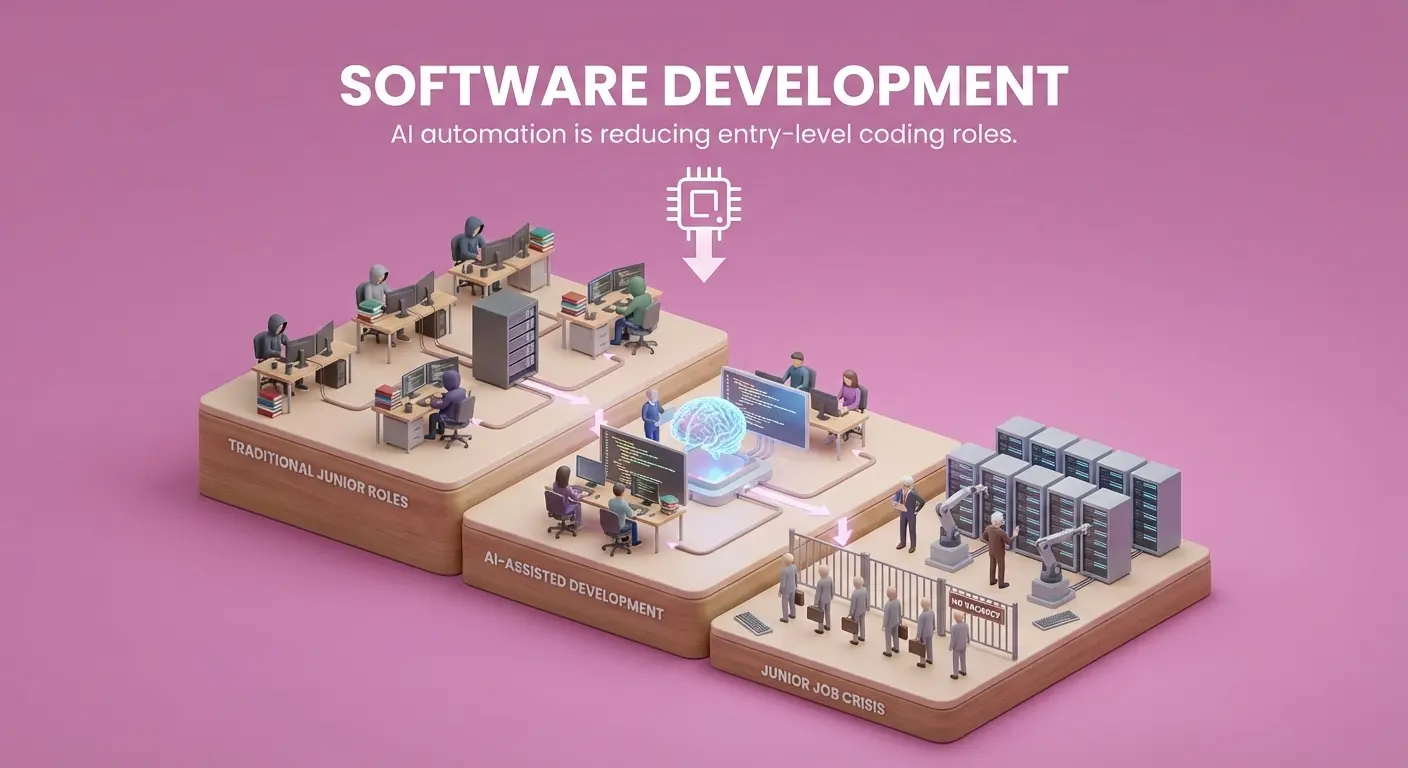
Now fast forward to 2026. A junior developer joins the same company. Their first task? Same thing. Build a CRUD application. They open ChatGPT. Or Claude. Or Copilot. Fifteen minutes later, the code is done. It works. It's even documented.
No broken databases. No 2 AM debugging sessions. No Priya sitting beside them explaining why their nested loops were "a crime against computing."
Sounds efficient, right?
Here's the problem: Rahul is now a senior architect. But who's going to replace him?
The Ladder Problem
Let's think about this like a ladder. Senior architects didn't wake up one day knowing how to design systems that handle millions of users. They climbed. Rung by rung.
The grunt work—those boring CRUD apps, those repetitive scripts, those "why won't this deploy" moments—that was Rung 1.
And AI just removed Rung 1.
So now we have juniors trying to jump directly to Rung 3. Some might make it. Most won't. Because you can't understand why systems break if you've never broken them yourself.
The Numbers Don't Lie
A recent Stack Overflow survey found that 76% of developers are now using or planning to use AI tools in their workflow. Great for productivity.
Entry-Level Market Data
The Hiring Cliff
Junior Postings
Companies are already reducing junior developer hiring. Why pay someone to learn on the job when AI can do the basics faster? A 2024 report from Revelio Labs showed that job postings for entry-level software roles dropped by nearly 30% compared to pre-AI levels.
We're consuming senior talent. But we're not producing it.
So What Do We Do?
AI is here. It's useful. It's not going anywhere. The question is: How do we train developers in a world where the training wheels have been automated?
1. Redefine "Junior" Work
If AI handles the basics, then junior roles need to shift. Instead of writing boilerplate code, juniors should be reviewing AI-generated code. Understanding its limitations. Finding where it fails.
2. Bring Back Mentorship
Companies that invest in structured mentorship programs—where seniors actually spend time with juniors, not just review their PRs—will have a massive advantage in five years. They'll be the ones with actual senior talent.
3. Create "Safe Failure" Environments
Create sandbox environments where breaking things is the point. Call them "chaos labs." The goal: simulate the struggles that used to happen naturally.
4. Systems Thinking Focus
The developers who'll thrive are the ones who understand how systems fit together. AI can write functions. It can't see the whole chessboard.
The Final Verdict
The senior architects working today? They have maybe 15–20 years left in their careers. The pipeline to replace them is drying up. If we don't fix this, we'll end up with a generation of developers who can prompt AI effectively but can't debug a system when the AI gets it wrong.
And systems will get it wrong. They always do.
Building a development team that can actually grow?
Whether you're setting up DevOps pipelines, scaling infrastructure, or trying to create systems where junior developers can learn and level up—we can help.




© 2026 Alpha Dezine. All Rights Reserved.
