The Great IT Reset:
Is AI Really Killing
The $1.5 Trillion
Services Industry?
Or is something far more interesting happening?
Feb 19, 2026
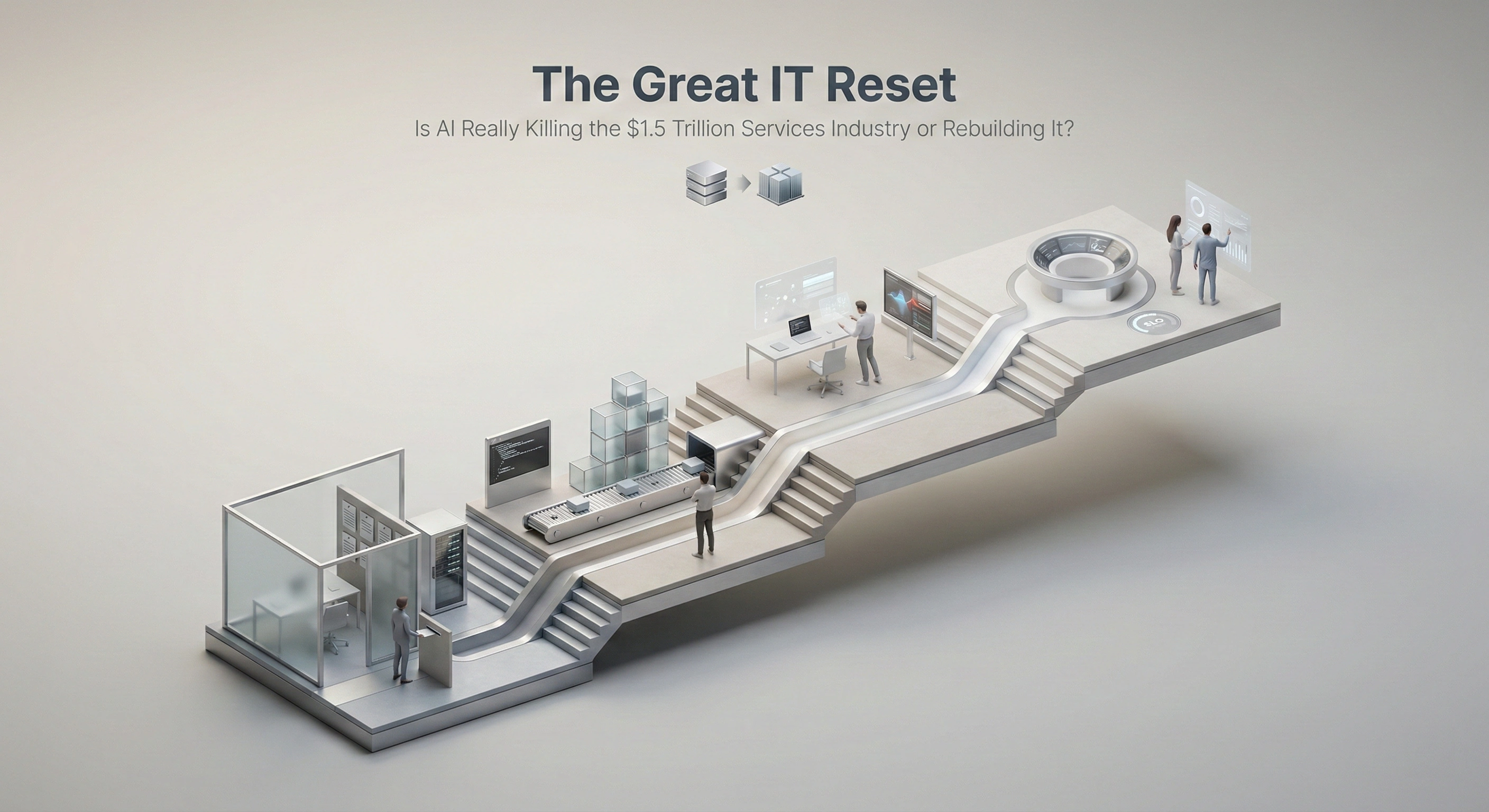
If you've been anywhere near LinkedIn and X (Twitter) lately, you've probably seen those viral posts predicting doom for the IT services industry.
Your CTO is probably fielding anxious questions from the board. Your IT vendor is suddenly talking about "AI transformation" in every call. And somewhere in a Slack channel, your engineering team is debating whether they'll all be replaced by Claude.
But here's the thing what's actually happening is far more nuanced. And honestly? Far more interesting.
If you're a business leader trying to figure out what this means for your company, your vendors, and your strategy this one's for you.
Let's break it down.
The Fear vs. The Reality
The panic isn't unfounded. When Anthropic released its Claude Cowork agentic plugin in early 2026, designed to automate contract reviews, regulatory compliance tracking, and sales forecasting, the market reacted. IT stocks tumbled. Analysts started writing obituaries for the traditional services model.
The fear is simple: If a mid sized company can now automate legal contract reviews internally using Claude or OpenAI Codex, why would they pay a consulting firm $300/hour for a team to do it manually?
The traditional IT services model was built on a straightforward equation: Your complexity = Their billable hours.
More complex systems meant more bodies on the project. More bodies meant more revenue. Everyone won except maybe your budget.
But here's what the doom scrollers are missing: AI isn't killing the industry. It's forcing a violent pivot.
The firms that adapt will thrive. The ones that don't? They're the ones those LinkedIn posts are written about.
The Productivity Revolution
Here's what's actually happening on the ground.
The major IT services firms Accenture, Deloitte, Cognizant, and others are seeing something remarkable. Headcounts are flattening or shrinking. But revenue? Holding steady or growing.
Fewer people. Same output. Sometimes more. Companies are reporting 25 40% productivity improvements across key performance indicators as a direct result of AI tools. Some development teams are seeing 300 500% gains on specific tasks like code generation, documentation, and testing.
Impact of AI Augmentation
Analysis of gains across development lifecycle phases (%)
That's not a dying industry. That's an industry undergoing a productivity revolution.
And here's why that matters for you as a business leader: The vendors who figure this out will deliver more value at lower cost. The ones who don't will keep charging you 2019 rates for 2019 productivity. The question is do you know which is which?
The Replacement Lie
Here's what the viral panic posts conveniently ignore.
AI is excellent at tasks. It can write code, generate documentation, run test scripts, and draft reports. It does these things faster than humans ever could.
But ask AI to take responsibility for a mission critical system at 3 AM when things go wrong?
Good luck.
The Human Moat
Think about what actually happens when systems fail:
Legal & SEC
When the SEC comes knocking about a trading algorithm that went haywire, someone needs to testify. AI can't sit in a deposition.
Cyber Recovery
When a ransomware attack hits, recovery requires human negotiation, coordination with legal counsel, and crisis communication.
Real-time Tradeoffs
When your e commerce platform goes down during Black Friday and you're bleeding $50,000 per minute, someone needs to make tradeoffs.
Strategic Failures
When a major system migration fails and the CEO is asking why the company lost $10M, someone needs to explain and take responsibility.
Remember the 2024 CrowdStrike outage that grounded flights and froze hospital systems worldwide? Recovery required thousands of engineers making judgment calls in real time. Not prompts. Humans.
Accountability Can't Be Automated
Here's the uncomfortable truth that AI enthusiasts don't like to discuss:
Liability
HIPAA violations carry personal liability. A hospital CIO can't tell regulators 'the AI did it.'
SOX / Audit
SOX compliance requires human sign off. CFOs personally certify that financial systems work correctly.
Insurance
Cyber insurance policies require human accountability chains. Insurers won't cover 'AI managed systems' without documented human oversight.
Clearance
Pentagon contractors need security clearances. AI doesn't get clearances.
Your bank doesn't run on prompts. It needs architecture. Security. Compliance. Governance. Integration across legacy systems that were built before some of your engineers were born.
The New Value Equation
AI replaces tasks. It doesn't replace responsibility.
The value is shifting from effort typing code for 8 hours to ownership using AI tools to control outcomes and taking accountability when things go wrong.
This distinction matters enormously when you're evaluating vendors or building your internal capabilities.
The Death of Billable Hours
This is where the transformation gets really interesting and really relevant for your business.
For decades, IT services built a beautiful for them business model: Your complexity = Their hours = Their revenue. Need a system integration? That's 10,000 hours. Security audit? 2,000 hours. Cloud migration? 50,000 hours. The meter was always running.
This model created perverse incentives. Efficiency wasn't rewarded it was punished. If a team found a way to do something in half the time, they'd effectively cut their own revenue in half.
The New Paradigm
Smart enterprises are moving from Time & Materials and fixed price models toward consumption based and outcome driven pricing. They're starting to pay for uptime, security, and results not for how many hours someone spent in a chair.
- "We'll bill you for 5,000 hours of development"
- "Here's our team of 20 engineers"
- "Change requests will be billed separately"
- "We'll guarantee 99.99% uptime"
- "Charge based on transactions"
- "Continuous optimization"
This shift has massive implications:
- For you as a buyer:You can finally align vendor incentives with your business outcomes. No more paying for bodies; start paying for results.
- For vendors:The ones who figure out how to deliver outcomes efficiently using AI as a multiplier will thrive. The ones still selling hours will race to the bottom on price.
The Demo vs. Production Gap
Here's something else to watch for: AI demos are cheap. Production systems are expensive.
Any vendor can show you a slick ChatGPT powered prototype in a pitch meeting. But production systems require backward compatibility with your legacy stack. Long term support contracts. Security hardening. Regulatory compliance. Integration with systems that haven't been updated since 2008.
The gap between "cool demo" and "actually works in your environment" is where real expertise lives. And it's where a lot of AI hype goes to die.
Evaluating Vendor Relationships
If you're working with IT services firms whether that's the big consultancies or smaller specialized shops here's how to think about evaluating them in this new landscape:
Questions to Ask Your Current Vendors:
Red Flags to Watch For
- • Vendors who suddenly rebranded everything as "AI powered" without changing their actual delivery model
- • Reluctance to discuss outcome based or performance based pricing
- • No clear answer on how they're training their workforce on AI tools
- • Over promising on AI capabilities without acknowledging limitations
- • Still pitching large headcount teams when the work could be done with smaller, AI augmented squads
Green Flags
- • Transparency about where AI adds value and where human expertise is still essential
- • Willingness to experiment with new pricing models
- • Clear investments in training and reskilling their workforce
- • Production case studies, not just innovation lab demos
- • A nuanced view that treats AI as a tool, not magic
The AI Transformation Strategy
If you're a small or medium sized business trying to figure out your own AI transformation, here's the uncomfortable truth:
You probably don't need to build everything yourself. But you definitely need to own the strategy.
The biggest mistake we see? Companies either: Ignore AI entirely hoping it's a fad that will blow over; it won't, or outsource everything handing over their AI strategy to a vendor who's optimizing for their own billable hours, not your outcomes. The right approach is somewhere in the middle: Own the strategy and outcomes. Leverage partners for execution.
Strategic Imperatives for SMBs
- 1
Get clear on where AI actually matters for your business Not every process needs AI. Focus on the ones where automation or augmentation creates genuine competitive advantage.
- 2
Start with outcomes, not tools Don't ask 'how do we use ChatGPT?' Ask 'what business results do we need to improve, and can AI help?'
- 3
Build internal AI literacy Even if you outsource implementation, your leadership team needs to understand enough to ask the right questions and evaluate vendor claims.
- 4
Demand accountability Whether you're building internally or working with vendors, someone needs to own the outcomes. AI is a tool, not a scapegoat.
- 5
Think about the long game The decisions you make now about AI infrastructure, vendor relationships, and internal capabilities will shape your competitive position for years.
The Winners and Losers
Let's be direct about who thrives and who struggles in this new landscape:
The Losers
- • "Body shop" vendors
- • Generalist firms
- • Billable-hour models
- • Vendors selling hype
- • Laggard businesses
The Winners
- • Outcome oriented partners
- • Domain specialists
- • Productivity leaders
- • Outcome-focused buyers
- • "AI Plus" Organizations
The Bottom Line
The IT services industry isn't dying. It's being violently reorganized.
The $1.5 trillion global industry that was built on complexity, headcount, and billable hours is transforming into something leaner, more accountable, and more valuable.
For business leaders, this is actually great news if you know how to navigate it. The vendors who figure out how to deliver outcomes not just hours will become genuine strategic partners. The ones who don't will become commoditized, racing to the bottom on price while delivering diminishing value.
The question isn't whether AI will change your vendor relationships and IT strategy. It's whether you'll be ahead of the curve or behind it.
The billable hour is dying.
Long live the outcome owner.
Making the Shift? Let's Talk.
Look, we've just spent a lot of words explaining that the future belongs to companies that pivot from "buying hours" to "owning outcomes." That AI isn't the enemy being unprepared for AI is.
But here's the uncomfortable truth: Most companies know they need to transform. They just don't know how.
This is exactly where Alpha Dezine comes in. We work with US businesses from growth stage companies to established enterprises to cut through the AI hype and build strategies that actually deliver.
We're not here to sell you another flashy demo that looks great in a boardroom but falls apart in production. We're here to help you:
Our approach is simple: We don't throw tools at problems. We understand your business first. We're obsessed with outcomes, not hours. And we stick around to make sure things actually work.
The companies that thrive in the next decade won't be the ones who ignored this shift. They'll be the ones who moved early, moved smart, and had the right partners in their corner.

© 2026 Alpha Dezine. All Rights Reserved.
