The ABC's of AI:
LLMs, RAG, and AgentsExplained Simply
Demystifying the technical jargon behind the next generation of business automation.
Dec 15, 2025
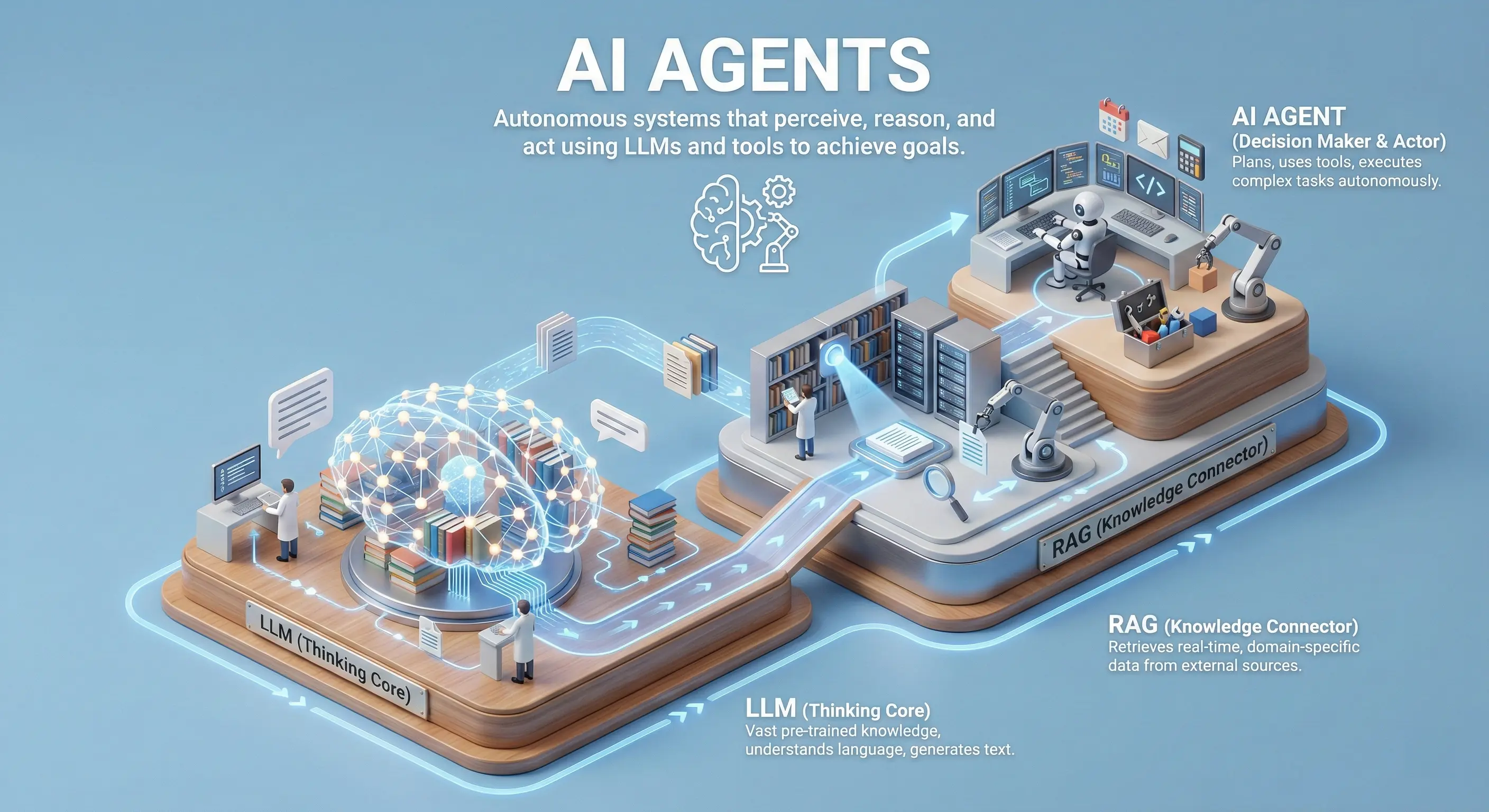
Quick Reference
- •LLM: The world-class brain that knows facts but lacks your company's data.
- •RAG: The digital library that connects the brain to your specific documents for accuracy.
- •Agents: The hands of the system that can actually execute tasks across your apps.
Today we are going to stop pretending we know what tech bros are talking about on LinkedIn, and finally explain the difference between an LLM, a RAG pipeline, and an AI Agent.
If you have walked into a meeting recently, you've heard the acronyms flying around like confetti.
"We need to leverage an LLM, maybe build a RAG pipeline for our proprietary data, and eventually deploy autonomous Agents to handle the workflow."
The AI industry is terrible at naming things. They take simple concepts and wrap them in scary tech-speak. So today, we're fixing that using a simple analogy: The New Hire.
1. The LLM (The "Know-It-All" Intern)
Imagine you hire a fresh intern named Kevin. Kevin is a absolute genius. He has read almost every book, article, and website on the internet. You can ask him to write a poem about corporate taxation in the style of Dr. Seuss, and he’ll do it in seconds.
Meet Kevin (The LLM):
- He has read billions of pages (Training Data).
- He understands language, tone, and logic perfectly.
- But Kevin has been living in a dark room for a year. He has no idea what happened this morning.
- If you ask him about your private internal sales figures, he won't know them. But he might make something up to sound smart (Hallucination).
In the tech world, Kevin is your Large Language Model (like ChatGPT-4, Claude, or Gemini). He’s the engine, but he’s missing your specific fuel.
Accuracy by Architecture
Proprietary data retrieval & task success rates
2. RAG (The "Open Book" Exam)
You realize you can’t trust Kevin with your specific company data. He doesn't know your license agreements, your HR policies, or your historical royalties.
So, you give Kevin a filing cabinet. Now, before Kevin answers, you give him a rule: "Don't just guess. Look in this cabinet, pull out the right folder, read it, and THEN answer me."
Retrieval
Finding the exact snippet of information in your mountain of PDFs or databases that answers the user's specific query.
Generation
Kevin (the LLM) takes those specific facts and uses his world-class brain to write a human-like response that is 100% grounded in truth.
3. AI Agents (The Intern Who Actually Does Stuff)
Now Kevin is smart (LLM) and he has access to your files (RAG). But there is still one major frustration: Kevin is trapped in the chat box.
If you say, "Kevin, that refund policy looks great. Please process a refund for our Michigan licensee," Kevin will look at you sadly and say: "I cannot do that. I am just a text generator."
This is where AI Agents come in. An Agent is an LLM that has been given arms and hands.
The Multi-Step Workflow
An agent breaks down your goal into steps: "First I'll find the order, then I'll check the royalty status, then I'll hit the API."
Tool Permissioning
You give the agent the "passwords" (API keys) to your software. It logs in, executes the click, and closes the loop.
The Bottom Line
The next time someone throws this word salad at you, just remember the Kevin analogy:
- 1LLM: The brain. It knows general knowledge, but it might lie.
- 2RAG: The library. It gives the brain the facts it needs to tell the truth.
- 3Agent: The hands. It takes the brain's decision and actually executes the task.
Why Should You Care?
Because this is where business is heading. We are moving from the era of RAG (chatting with our data) to the era of Agents (letting AI do our actual chores).
A year ago, we marveled at ChatGPT writing poems. Today, companies are building AI agents that can handle customer support tickets end-to-end, research, draft, and send emails, and even automate entire compliance workflows.
Building "Kevin" is a Headache.
Skip the API nightmare. Alpha Dezine builds the custom RAG pipelines and Agentic workflows that secure your proprietary data and automate your grunt work—so you can focus on the big picture.
Talk to an AI Specialist



© 2026 Alpha Dezine. All Rights Reserved.
