The Complete Guide to
Getting a CLC License:A Step-by-Step Guide for Brands
Everything you need to know about CLC licensing fees, royalties, application steps,
and approval requirements.
April 14, 2026
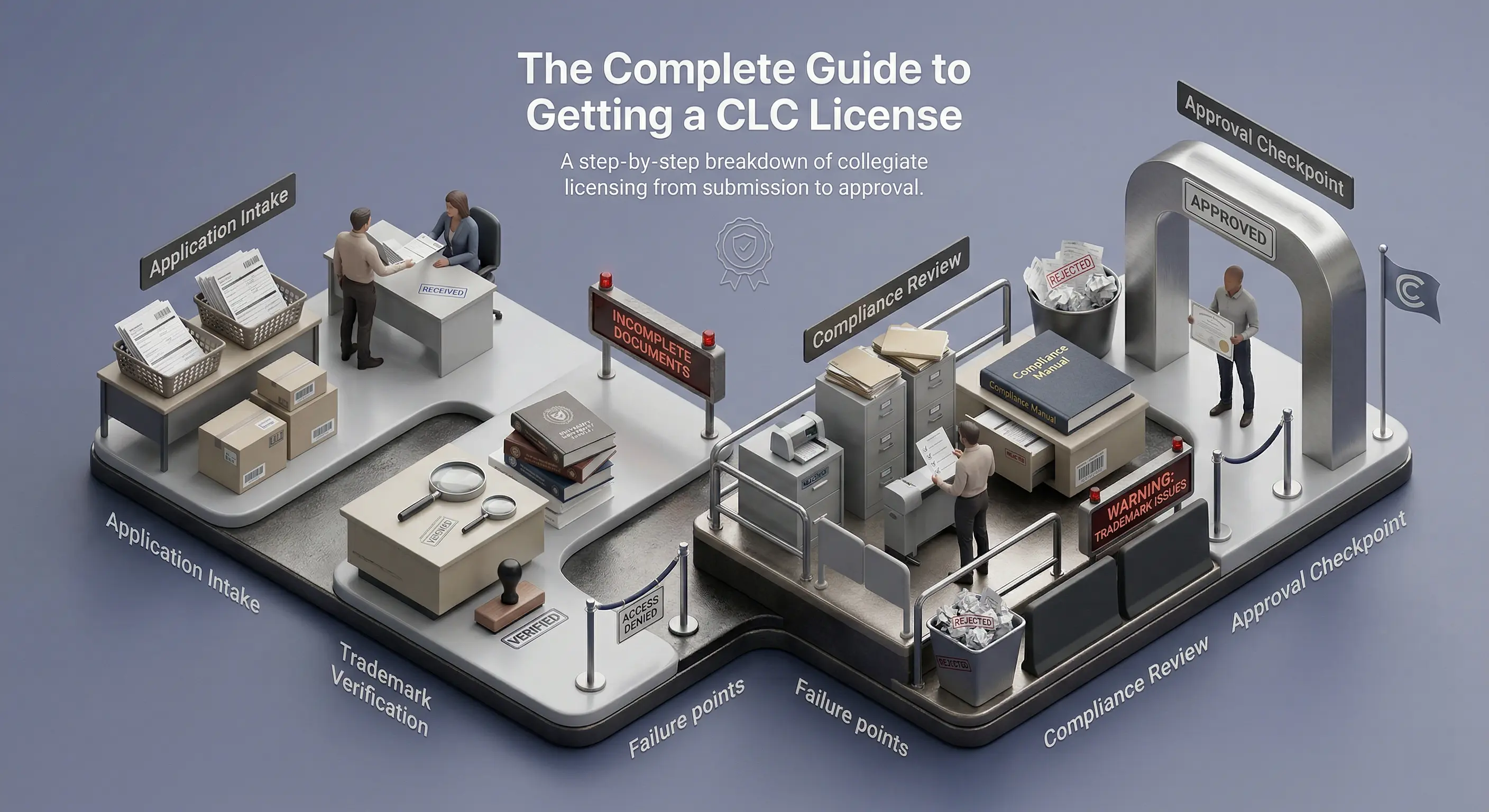
Let's set the scene.
You run a small apparel brand. Business is going well. Then a retailer pulls you aside and says, "If you could get an official license to put a Michigan or Alabama logo on these, we'd order ten times the volume."
Your eyes go wide. You think: how hard can it be? Harder than most people expect. But also very achievable, as long as you know the rules before you play the game.
This guide covers everything. What CLC is, how to get licensed, what it costs, which path is right for your brand, and the mistakes that sink applications before anyone even reads them properly. Let's go.
What Is CLC and Why Does It Matter?
CLC stands for Collegiate Licensing Company. It is the largest collegiate trademark licensing and marketing agency in the United States, headquartered in Atlanta, Georgia.
Here is the simplest way to think about it. Universities are the talent. Your brand wants to work with them. CLC is the agent sitting in the middle, deciding who gets access and who does not.
CLCCollegiate Licensing Company: The leading collegiate trademark licensing agency represents more than 700 colleges and universities across the country. It also covers athletic conferences, bowl games, the NCAANational Collegiate Athletic Association: The organization that regulates student athletics, the College Football Playoff, the Heisman Trophy, and other major collegiate brands. That is not a small operation. That is practically the entire collegiate merchandise universe under one roof.
Here's how it works:
It's passive income for universities, and it's substantial. The University of Texas makes over $15 million annually just from licensing. Alabama? $12 million. Ohio State, Michigan, Notre Dame? All over $10 million each. Over 200 universities in the US each pull in more than $1 million yearly just from letting companies use their logos.
The Evolution of Collegiate Licensing
The collegiate licensing landscape didn't emerge overnight. It has evolved from a fragmented, unregulated space into a highly structured, multi-billion dollar industry. Here are the key milestones that shaped the market we see today.
The Foundation
Bill Battle founds the Collegiate Licensing Company (CLC), creating the first centralized agency to manage and protect university trademarks.
The First Major Deal
The University of Alabama signs on as CLC's first major client, setting the precedent for formal collegiate trademark protection.
The IMG Acquisition
Global sports and media giant IMG acquires CLC, bringing unprecedented scale and resources to collegiate licensing.
The Mega-Merger
WME acquires IMG, eventually leading to the formation of Learfield IMG College, consolidating the majority of collegiate multimedia and licensing rights.
The NIL Era Begins
The NCAA changes its rules to allow student-athletes to profit from their Name, Image, and Likeness (NIL), creating a massive new frontier for co-branded merchandise.
Do You Actually Need a CLC License?
Yes. If you want to sell officially licensed collegiate products, you need one. Without it, you are operating without permission. Universities and CLC actively monitor and enforce this. Their enforcement and legal team is not a small one.
And here is something that surprises people: it is not just about selling at retail. Anyone or any business wishing to use a university's trademarks or name on any product needs a license before offering that product for sale. This includes selling to university departments, campus organisations, and even student groups. Premiums, promotions, and advertising are included too.
But here is the nuance. Not every license is the same. There are four types available, and choosing the wrong one can waste weeks of your time.
CLC vs. Going Independent: Which Path Makes More Sense?
This is a question smart brands ask early on. Do I have to go through CLC, or can I work directly with a university?
Fair question. Here is a straight answer.
Some smaller schools manage their own in-house licensing programs. So yes, you could approach certain universities directly without going through an agency at all. Other agencies also exist in this space, including Affinity Licensing and Nexus Licensing. Different schools work with different agencies. Your first job is always to find out which agency, if any, manages the school you want to work with.
But here is the reality check. If you want access to the biggest college brands, the schools with the most passionate fan bases and the most retail demand, those are CLC schools. And there is no shortcut around that.
Here is how to think about the two paths side by side.
Going Independent
The Upside
A simpler process with fewer requirements and potentially lower fees. If you are a small brand testing the waters with one or two local schools, this can work. Some schools manage their own programs with less bureaucracy, and getting approved can be faster.
The Downside
You are limited in reach. You cannot access CLC schools this way. You will need to manage separate agreements with each school individually. And you will not benefit from the consolidated reporting and royalty infrastructure that CLC provides.
Best for: Local brands, regional players, or businesses focused on one or two specific schools.
Going Through CLC
The Upside
Scale. One application process can give you access to hundreds of institutions. You get a standardised reporting system, consolidated royalty management, and the credibility of being an officially vetted CLC licensee.
The Downside
A more demanding process, more upfront requirements, and ongoing fees across multiple layers. It takes time and preparation to do it properly.
Best for: Brands serious about building a collegiate merchandise business at scale with existing retail relationships.
| Feature | CLC Licensing | Independent |
|---|---|---|
| School Access | 700+ Institutions | 1 at a time |
| Application Process | Standardized, Centralized | Varies by school |
| Royalty Reporting | Single Portal | Multiple Systems |
| Initial Cost | Higher (Fees + Advances) | Lower (Usually) |
Think of it this way. Going independent gets you into one room. Going through CLC gives you a key to 700 rooms at once. The tradeoff is more doors to knock on before you get the key. For most growth-minded brands, that tradeoff is worth it.
How to Get Your First CLC License: Step by Step
You have decided to go for it. Here is exactly how the process works, without the confusion.
Fair warning before we begin: the process has more steps than most people anticipate. But each step exists for a reason, and knowing them in advance puts you miles ahead of most applicants.
Step 1: Validate Before You Apply
Before you spend time or money on applications, confirm two things. Is the school genuinely interested in your product category? And do you have real retail interest confirmed on the other side?
Step 2: Find Out Which Agency Manages Your Target School
Once you know the school is interested, confirm which licensing agency manages their program. It might be CLC, Affinity Licensing, Nexus Licensing, or the school's own in-house team. Once you know, reach out to the right agency to get an application.
Step 3: Complete the Application in Full
The application will ask for a detailed business plan. This includes your sales channels, your marketing approach, and your projected sales figures. For a Retail License, you will also need to submit financial statements, a full institution list, a company name and label sample, and your licensing contact information.
Step 4: Submit a Product Sample
All Retail License applicants are required to submit at least one quality sample of each product they plan to sell with collegiate logos. The sample does not need to feature actual school logos, but it must demonstrate your production method, whether that is screen printing, embroidery, heat transfer, or something else.
Step 5: Pay the Application Fee
The application fee covers the agency's cost to review your submission. For a CLC Retail License: $250 for a single school, and $125 for each additional school. For an Internal License: a flat $250 regardless of how many schools. For a One Time Use request: $100.
Step 6: The Two Stage Review
Once submitted, the agency reviews your application first, checking that everything is complete and meets their technical requirements. Once it passes that stage, it goes to the school for a strategic review.
Step 7: Phase II: Artwork, Insurance, and Holograms
Once your application receives preliminary approval, Phase II begins. This is where things get more detailed. At this stage you will need to submit designs with official school logos and marks through CLC's Brand Manager 360CLC's online portal for managing license applications and artwork approvals system.
Step 8: Final Sample, Agreement, and Sign Off
After artwork approval, a finished sample of the actual product goes in for final review. Once everything clears, CLC sends over a License Agreement for you to sign electronically. After both parties sign, you are officially licensed and authorised to produce and sell.
The Real Cost of Collegiate Licensing
This is where most brands get caught off guard. A CLC license is not a one time payment. It is an ongoing financial relationship with multiple layers. Let's break all of them down clearly.
Layer 1: Application Fees
These are paid upfront when you submit your application.
For a Retail License: $250 for the first school, $125 for each additional school. For an Internal License: $250 flat, any number of schools. For a One Time Use request: $100.
Layer 2: Royalty Advances
Many schools require an advance royalty payment at the point of signing the License Agreement. This is a non-refundable upfront payment that gets credited toward your future royalty obligations. Think of it as a deposit on your relationship with the school. The amount varies by school and product category.
Layer 3: Annual Administration Fees
After your first year, you pay an annual renewal fee to CLC. Here is how it scales:
• 1 school: $200 flat
• 2 to 5 schools: $500 flat
• 6 or more schools: $150 per school, with a maximum cap of $17,500
Layer 4: Royalties
This is the biggest and most ongoing cost. Royalty rates in collegiate licensing typically fall in the 10 to 15 percent range on net sales, depending on the school and product category. Some licensing attorneys note that many individual schools require royalties closer to 15 percent.
Royalties are calculated based on net sales of all licensed products sold during the term of the agreement. A sale is deemed to have been made when licensed articles are billed, invoiced, shipped, or paid for, whichever happens first.
Monthly royalty reporting is required for all Retail licensees. You submit your sales data and pay what you owe on a monthly basis.
Layer 5: Minimum Royalty Guarantees
Many schools require a minimum annual royalty guarantee on top of the standard royalty rate. This means you owe that minimum amount to the school regardless of how much product you actually sell. If your sales do not generate enough royalties to hit the minimum, you still pay the shortfall.
If a licensee fails to generate royalties that meet or exceed the advance payments and minimum guarantee amounts during any annual period, it constitutes a breach of the license agreement. In plain terms: not meeting your minimum is not just a financial hit. It can cost you the license entirely.
Layer 6: Insurance and Other Requirements
Licensees are required to maintain the appropriate level of insurance at all times and keep CLC listed as an additional insured on the policy. If the school requires affiliation with the Fair Labor AssociationFair Labor Association: A non-profit collaborative effort to improve working conditions globally, that is an additional obligation too.
The honest takeaway: collegiate licensing is a serious financial commitment with costs spread across application, advances, annual fees, royalties, and insurance. The brands that succeed are the ones that come in with a real distribution plan, confirmed retail relationships, and the financial runway to sustain these obligations while the business builds momentum.
5 Reasons CLC Applications Get Rejected (And How to Avoid Them)
You put in the work. You filed the application. And then you get rejected.
It happens more often than people realise. Here is exactly why, and more importantly, what you can do about each one.
1. Poor Product Quality
All vendors need to prove they are reputable companies. Along with submitting general business information, they must maintain the appropriate level of insurance and send in a sample of their work. If they are unable to meet the requirements or the sample is of poor quality, they will not be approved.
Your sample is your first physical impression with the school. If it would not comfortably sit on a retail shelf next to established brands, it is not ready. Do not send a prototype you are not fully proud of.
2. Incomplete or Vague Application
Retail License applicants are required to provide as much detailed information as possible in the application to improve the likelihood of acceptance by institutions. Evaluation criteria typically include the business and marketing plan, existing product distribution and retail relationships, financial history of selling licensed products, and the uniqueness and commercial viability of the product.
A thin business plan with unclear distribution channels and rough sales estimates signals to schools that you have not thought this through. Schools want to see that you have a credible, specific path to market. Vague applications get passed over in favour of ones that demonstrate preparation and commitment.
3. Applying for Too Many Schools Too Soon
This one is counterintuitive. It might seem like casting a wide net shows ambition. To institutions, it often signals that you are not prepared to maximise any one of them.
CLCCollegiate Licensing Company: The leading collegiate trademark licensing agency strongly recommends that applicants only apply for schools they are genuinely prepared to activate and maximise in the near term. Applying for 50 schools when you have the operational capacity for 5 is a red flag, not an advantage.
4. Existing Exclusive Agreements in Your Product Category
Some schools already have exclusive arrangements with specific vendors in certain product categories and distribution channels. If your product falls into one of those locked categories, you will not get approved regardless of how strong your application is.
This is one of the most frustrating rejection reasons because it has nothing to do with the quality of your product or your business plan. It is simply a structural barrier.
5. Selling or Producing Before the Agreement Is Fully Signed
This catches eager brands all the time, and it is completely avoidable.
You receive preliminary approval. Retailers are excited. You start making commitments, producing inventory, or booking trade show space. Then the deal hits a snag or gets delayed. Now you are exposed.
Until a licensee receives fully executed copies of the License Agreement, signed by both parties, they remain unauthorised to produce or distribute any merchandise incorporating the institution's trademarks. Period.
CLCCollegiate Licensing Company: The leading collegiate trademark licensing agency also strongly recommends not pursuing detailed sales discussions or trade show planning until the full licensing process is complete.
Where Alpha Dezine Comes In
Here is something most licensing guides will not tell you.
Getting a CLCCollegiate Licensing Company: The leading collegiate trademark licensing agency license is just the beginning. Once you are approved, the real work starts. And it involves more moving parts than most brands are equipped to manage on their own.
Think about what life looks like post-approval. Every product design must be submitted for approval before you can produce it. Not just the first one. Every single design, every new item, and even reprints and reorders need to go back through the system each time. Monthly royalty reports need to be filed without fail.
Insurance documentation needs to stay current. New product submissions require specifications and samples. And if you are managing licenses across multiple schools, each with their own requirements, the administrative load compounds quickly.
Most brands try to manage all of this through email chains, spreadsheets, and a lot of manual back and forth. It works until it does not. And when it breaks down, it creates compliance risks, delayed approvals, and lost revenue.
This is exactly where Alpha Dezine helps.
Alpha Dezine works with brands navigating the collegiate licensing process, from the initial application stage all the way through to the day-to-day operations of running a licensed programme. This includes setting up artwork approval workflows, building the systems that handle royalty reporting and documentation, and integrating the tools that keep everything moving cleanly in the background.
For brands that are just starting out, Alpha Dezine helps you go into the application process prepared, organised, and positioned to be taken seriously. For established licensees whose operations are starting to crack under the weight of managing multiple schools, Alpha Dezine rebuilds the infrastructure so compliance becomes a process rather than a panic.
The difference is significant. Instead of spending hours chasing approvals through email threads, brands working with Alpha Dezine have structured workflows that move faster, make fewer errors, and keep every school relationship running smoothly.
You focus on building the product and growing the business. The systems that keep your licensing programme compliant and operational are what Alpha Dezine handles.
Without Support
- Scattered email threads with multiple stakeholders
- Missed deadlines and delayed product launches
- Manual spreadsheets prone to human error
- Compliance gaps risking license revocation
With Alpha Dezine
- Clean, structured workflow in one central hub
- Clear approval stages with automated reminders
- Automated royalty reporting and calculation
- Full visibility and guaranteed compliance
So. Is Your Brand Ready for This?
Collegiate licensing is one of the most powerful commercial opportunities available to product brands right now. The market is enormous, fan loyalty is fierce, and demand for officially licensed merchandise is not slowing down.
But it is not a shortcut. It is a structured, process-driven industry built on compliance, quality, and mutual trust between brands and institutions. And it comes with financial obligations that do not disappear if your sales are slow.
Here is the full journey in plain terms.
The 4-10 Week Timeline
Application
Week 1Submit business plan, retailer list, and initial fees.
Review
Weeks 2-4Agency and institution review your submission.
Phase II
Weeks 4-7Submit artwork, insurance, and hologram requests.
Final Approval
Weeks 7-9Sign the fully executed License Agreement.
Go Live
Week 10+Begin production, sales, and monthly reporting.
It takes between four and ten weeks on average. It costs more upfront than most brands budget for. And it requires consistent monthly reporting, royalty payments, and design approvals for every product you want to produce.
But if you do it right, with the right preparation, the right systems, and the right partner supporting you, you get access to more than 700 schools, millions of passionate fans, and a market that rewards the brands who play by the rules.
Ready to navigate collegiate licensing without the confusion?
Alpha Dezine helps brands go from application to approval with the right systems, the right workflows, and none of the unnecessary chaos. Stop managing licenses in spreadsheets.


© 2026 Alpha Dezine. All Rights Reserved.
