Why You Won't Find
Oxford University
T-Shirts at aLondon Sports Shop
A deep dive into the uniquely American market of collegiate licensing, and why the model doesn't translate across the Atlantic.
Nov 26, 2025
Key Takeaways
- •The US collegiate licensing market is a $6B+ industry, virtually non-existent in Europe.
- •Success relies on four unique ingredients: Identity, Sports Business, Alumni Loyalty, and Professional Organization.
- •NIL (Name, Image, Likeness) is creating a new "gold rush" for personalized merchandise.
Picture this: Now imagine you're at Heathrow Airport in London. You'll see Manchester United jerseys. Liverpool scarves. Arsenal jackets. But Oxford University hoodies? Cambridge sweatshirts?
It will be akin to finding a unicorn.
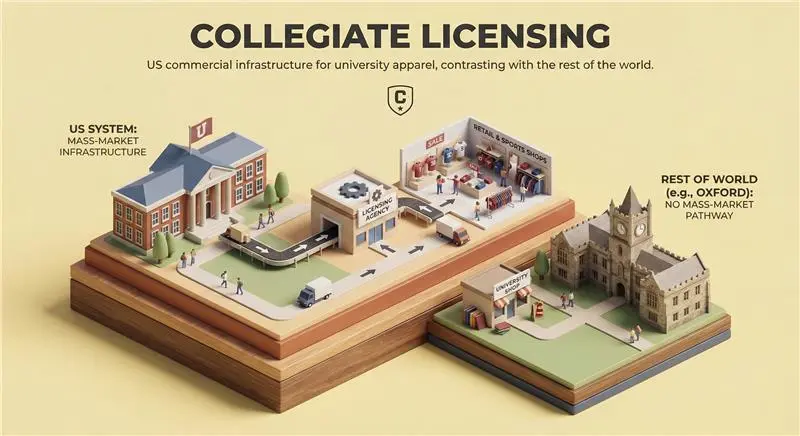
Here's the weird part: Both countries have prestigious universities. Both have sports-crazy populations. So why does America have a $6+ billion industry built on selling university-branded merchandise, while the rest of the world simply... doesn't? Let's dig in.
What is Collegiate Licensing?
Think of it like a franchise model, but for logos. A university owns valuable intellectual property: its name, logo, mascot, colors, and even specific phrases (looking at you, "Hook 'Em Horns"). Instead of keeping this locked away, they license it out to manufacturers who want to slap these symbols on everything from t-shirts to toilet paper. Well, maybe not toilet paper. But you get the idea.
Here's how it works:
- 1A company (let's say a hat manufacturer) wants to make University of Michigan caps.
- 2They apply to Michigan (or more likely, to Michigan's licensing agency).
- 3If approved, they pay an upfront fee and agree to pay royalties—usually 8-12% of wholesale price.
- 4Michigan reviews and approves every single design.
- 5The manufacturer makes and sells the hats.
- 6Michigan collects checks every quarter.
It's passive income for universities, and it's substantial. The University of Texas makes over $15 million annually just from licensing. Alabama? $12 million. Ohio State, Michigan, Notre Dame? All over $10 million each. Over 200 universities in the US each pull in more than $1 million yearly just from letting companies use their logos.
Top Earners (Estimated)
Annual Licensing Royalties (USD Millions)
The 4 Ingredients
Why does this work in the US and nowhere else? It requires a perfect storm. Remove any one, and the recipe fails.
1. The Tribe
College isn't just school—it's identity. You don't just attend Alabama; you become a Crimson Tide fan. This doesn't happen with commuter schools in Europe.
2. Sports as Big Business
NCAA football viewership rivals the NFL. No eyeballs = no merchandise demand. The UK has no primetime Saturday games for university rugby.
3. The Alumni Network
A customer base that literally renews itself annually and maintains loyalty for life. 20M+ students, all potential buyers for decades.
4. Organization
Agencies like CLC (Learfield) professionalize the chaos. They vet thousands of applicants and collect royalties so universities don't have to.
Who's making all this stuff?
The Apparel Monarchs
Nike, Adidas, Under Armour. They sign exclusive deals worth $100M+ to outfit athletic departments. Nike's deal with Ohio State? 15 years, $252 million.
The Vertical Giant
Fanatics. They license, manufacture, AND sell directly online. When a team wins at 11 PM, merch is ready by midnight.
The Category Specialists
Top of the World (hats), Wincraft (decals). Plus hundreds of niche licensees making everything from dog collars to BBQ sets.
Can anyone become a licensee?
In theory, yes. In practice, it's tough. Universities (and their agencies) are selective. You need more than just a cool idea.
The Gatekeeping Checklist:
- A solid business plan
- Proof of insurance
- High-quality product samples
- Financial stability
- Willingness to pay admin fees + advance royalties
The Real Challenge: Approvals
Every. Single. Design. Must. Be. Approved.
Want to make a funny t-shirt with the mascot doing something silly? Rejected—doesn't align with brand guidelines.
Want to use slightly the wrong shade of blue? Rejected.
Want to use the logo but also add your own design elements? Better submit it for approval and wait 2-4 weeks.
Universities are fiercely protective because their brand is worth billions. One poorly made product or offensive design could damage that.
What's Changing?
The market is transforming thanks to one acronym: NIL (Name, Image, and Likeness). Student-athletes can now profit from their fame, meaning vendors can make deals directly with star quarterbacks, not just the university.
"Imagine buying a t-shirt with both the Alabama logo AND the star quarterback's signature. That's the new frontier."
Other Trends Reshaping the Market:
- Direct-to-consumer is king: Why sell through Dick's Sporting Goods when you can keep bigger margins online? Fanatics dominates here, but smaller brands are finding success too.
- Boutique over basic: Mass-produced, generic hoodies are losing ground to premium brands offering vintage designs, better materials, and unique styles. Think of it as the craft beer movement, but for college merch.
- Sustainability matters: Younger consumers care about environmental impact. Smart vendors are adapting with eco-friendly materials and ethical manufacturing.
The Bottom Line
Collegiate licensing is a perfect storm that can only exist in America. You need: universities as identity-formation institutions + college sports as mainstream entertainment + massive scale + professional organization + lifelong alumni loyalty.
Remove any one ingredient, and the recipe fails. That's why Oxford doesn't have a licensing industry despite being older and arguably more prestigious than most American universities.
It's also why this $6+ billion market isn't going anywhere. As long as Americans form deep emotional bonds with their universities, they'll want to wear, display, and celebrate those connections.
It's more than merchandise. It's identity in physical form. And you can't put a price on that.
Turn the Nightmare into a Machine.
All this complexity, the approvals, the vendors, the compliance, the royalty tracking doesn't have to run on email chains and broken spreadsheets anymore. Alpha Dezine built software specifically for this industry (not a generic tool trying to fit).
Trusted by 250+ licensing agencies, universities, and vendors, our platform cuts approval cycles from 14 days to 2 days, handles 400+ approvals daily, and integrates seamlessly with existing systems like Learfield, CLC, and Fanatics.